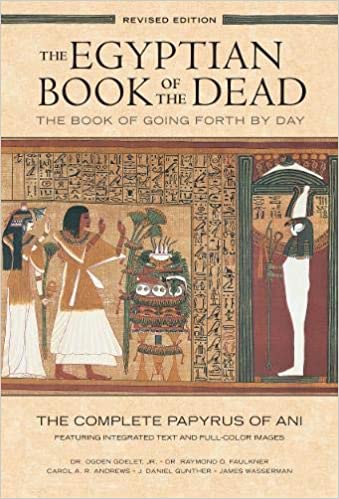
The Book of Going Forth By Day: The Complete Papyrus of Ani
Summary
The Egyptian Book of the Dead is an Egyptian book of spells that provide insight into the trials one will face in the afterlife and how to overcome them. This particular book includes incredibly clear photos of the Papyrus of Ani, the most intact version of The Egyptian Book of the Dead, along with many other chapters that were not present in Ani’s papyrus. It also includes a very thorough commentary on the text to explain what appears on the papyrus of Ani even further.
Review
At 180 pages, this book is deceivingly long, as the pages are 4 times the size as a regular book and often filled entirely with text. It is also a somewhat difficult text to get through, and a reader with no knowledge of the Egyptian gods and afterlife will have to rely heavily on the commentary at the end of the book to make any sense of what it written. For the more visual, the images of the actual Papyrus are fantastic, and the commentary does a great job of going through and explaining the finer points of the images in the papyrus.
Reflection
The Egyptian Book of the Dead is a collection of writings and images that served as a funerary text. It is not a Bible or even a story so much as a book of spells that were going to be useful to a deceased person in the afterlife. These spells included how to open your mouth in the afterlife, how to prevent your heart from being taken from you, how to breathe air, and many even stranger spells that enable you to transform into animals. There is even a spell for not dying again in the afterlife.
The book of the dead originally started as the pyramid texts, inscriptions written on pyramids that were intended to guide whoever was buried there in the afterlife. These writings would see another iteration as the coffin texts when wealthy people started having the inscriptions etched in their coffins. Ultimately these texts were put on scrolls that could be buried with a person, making a luxury once reserved for royalty even more widely available for the other rungs of society. In a way, it meant the afterlife itself was available not just to royalty or the extremely privileged class, but to others as well.
There have been thousands of copies discovered and translated – the scroll made for a scribe name Ani, written around 1250 b.c. just happens to be the most clear and famous. It is over 70 feet long and the fact there is a translation available to us is an interesting story that includes a British scholar buying artifacts from less than reputable antiquities dealers and taking those artifacts to England. In a strange way, as the names of Ani and his wife Tutu live on to this day, the papyrus served its purpose of providing them with immortality.
It suffers from the problems many old texts do. The study of ancient Egypt and Egyptian texts started with centuries of misguided speculation before the Rosetta Stone began to make the discipline more scientific. Even with a Rosetta Stone providing guidance, there are many possibilities for interpretation, and ultimately this text considers interpretations/translations of people who spoke different languages all kind of merged into one. As a reader goes through he or she will sense enough open ends and problems in translation to inevitably yearn for the original meanings of the images and inscriptions in this mysterious book, which have sadly been lost to the sands of time.
The commentary at the end of the book does help fill in some of these gaps and mitigate that feeling. I fumbled through a few of the platelets of the Ani papyrus before discovering the commentary at the end of the book. I feel the best way to digest the text was to read the text translations from the papyrus and the commentary on those sections at the same time.
Even with the commentary to explain things as you go along, it is not an easy read. It feels more like trudging through a textbook than something you would read for pure entertainment. There also isn’t a ton of actionable information in most of the book of the dead. Spells to turn yourself into a heron or avoid being decapitated in the next life have a novelty factor in their strangeness, but after dozens of strange spells that I won’t remember in two weeks, let alone all through this life and the afterlife, I’ll admit I was almost ready to give up on this one.
That’s when I hit the platelet with the negative confessions/declarations of innocence. This series of confessions to a tribunal of the gods provides a ton of insight into the Egyptian moral code. Emphasis in some of the confessions on not killing, lying, and stealing may have served as inspiration for several of the 10 commandments. Some offenses are so major they are mentioned twice in a row – sleeping with a married woman was clearly highly villainized in Egyptian society.
But there are also some that surprise you, as we wouldn’t consider them majors offenses. One that shows up in other Egyptian books of the dead (though not present in the papyrus of Ani) is “I have not made daily labor in excess of what was due to be done for me,” perhaps a subtle warning against workaholism in the Egyptian moral code. There are also elements of behaving respectfully toward the environment in the confessions as well.
Morality was important to Egyptians, and they clearly believed what you did in life mattered in the afterlife. Central to the Egyptian idea of the afterlife is a scene or trial in which the heart of a deceased person is weighed against a feather. A pure heart will pass this test – and there are spells to keep your heart from testifying against you in case you are worried. A heart “heavy” with transgressions will fail this test, and result in the person being fed to an alligator-headed god/monster, just one of the many pitfalls the Egyptians believed could face you in the next life.
Moral of the story, the Egyptian book of the dead provides a lot of … interesting instruction for an afterlife reminiscent of a horror film where the main character must do everything right just to survive. But the book provides at least some practical insight to the moral code of Egyptians, and as their civilization lasted longer than any others we know of, perhaps there are some things we can learn from them.
 Dude on the Path Book Reviews