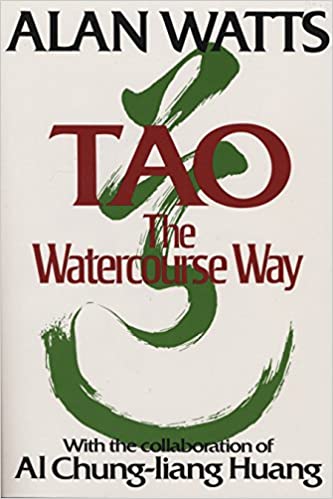
By Alan Watts
Summary:
Alan Watts gives readers who may have no background on the subject a sense of some of the key concepts of Taoism. Concepts like the Tao, ying and yang, Wu-wei, and te are explained through Taoist literature and metaphors.
Review:
At 128 pages, this is perhaps the best introduction to the Chinese philosophy of Taoism I can think of. It is a quick and easy read. I actually read it a couple years ago, and happily re-read it over a weekend to do this review.
Reflection:
I suppose I should disclose in advance that I love Alan Watts and will be reviewing many of his books. I honestly don’t think I’ve come across even one of his books or lectures I didn’t like or learn something from. He does a great job explaining Eastern philosophies that are completely foreign to most people in the western world.
The origins of Taoism trace back to the writing of of 3 or 4 key individuals. The first of which was Lao-Tzu, a name that means “old boy” a sort of pun and homage to the legend that he was born with a big grey beard. Lao-Tzu was supposed to have lived sometime between the 6th and 4th century b.c. in the Chinese city of Chou. Upon recognizing the impending downfall of the dynasty, he decided to leave, but was stopped by a guard at the gate who asked him to write down his thoughts. This book would later be known as the Tao te Ching, the fundamental text of Taoism.
Whether or not this actually happened, or if the Tao te Ching is actually a collected book of saying from many authors as scholars believe, you can believe as you wish. What is not up for debate was the next iteration, that expanded upon some of the ideas in a slightly different format arrived around the 4th century was written by someone named Chuan Tzu. Even more was written by Lieh-Tzu and Huai Nan Tzu.
There are several fundamental ideas in Taoism, and the book explains them in terms a westerner who was never exposed to them in their upbringing can understand. I think the most interesting to explore is the concept of the Tao – which Watts does in chapter 2.
Any attempt to describe the Tao is difficult at best. Any description has to fall short, as the Tao is something that can’t be reduced to words. Lao-Tzu even begins the Tao te Ching with this warning: “The Tao which can be spoken of is not the eternal Tao.” And yet, he proceeded to write an entire book on the subject. I guess we all just give it our best shot.
My completely “101” understanding of Tao (as an American with no formal education on the topic) is that it could be thought of as the force behind the general unfolding of all things, events, beings, existence itself. It has a more natural feel to it than a divine creator pulling the puppet strings of an earth full of objects it created. That is not to say that the Tao is not creative – The Tao te Ching even mentions The Tao loves and nourishes all things – but does not lord it over them. It has the natural, nurturing feel of a mother rather than the controlling tough love of a father.
I think something like the Tao is best understood through example or metaphor and for this, the natural world and water seem to be the most commonly used. I think of the examples plants growing toward light and water always finding a way to flow to lower ground – neither of these things do what they do by any conscious force or compulsion, they just do it naturally on their own accord.
The concept of mutual arising of things in nature is helpful to explain how the Tao sort of all works together as a unified whole – like a brilliant natural system. The example of bees and flowers for example: you won’t find flowers where there are no bees to pollinate them, and you won’t find bees where there are no flowers to pollinate and use for their food. They arise mutually, dependent on each other.
I think this is a powerful idea that says one thing loud and clear: the Tao creates things to exist in a precise balance and doesn’t seem to make mistakes or create extra waste. Every single thing that exists arose for a purpose – serve some role in the universe. A logical extension of this thought it that YOU clearly arose to serve some purpose in the universe. It may be tough to see at first, but it’s there. Don’t stop looking.
Water is by far the most commonly used metaphor in Taoism, with ideas of the “flow” of the Tao being commonly used. This is the reason for the title of the book: the watercourse way.
I think of the Tao as a river, and we are along for the ride in that river. If you struggle against it and try to swim against the current, you will wear yourself out and get nowhere. Go with the current, and you gain the full force of the river behind you with little effort on your part.
This brings up the concept of Wu-wei or natural action – which Watts covers in the third chapter. Struggling against the Tao is a senseless activity, it is best to act in accordance with it. How does one try to act in accordance with the Tao? It seems to be one of those things like a golf swing or yoga pose, you only make things worse by “trying” extra hard. Better to just relax and let things flow.
Bonus material:
Below is one of my favorite Alan Watts lectures on Taoism that covers a lot of the same topics in this book:
 Dude on the Path Book Reviews