by Ram Dass
Summary:
Former Harvard psychiatry professor Richard Alpert describes his spiritual transformation into Baba Ram Dass. This includes an autobiographical account of his early psychedelic years and his time spent with his Guru in India, pages of random enlightened sayings and artwork, and a guidebook for implementing spiritual practices in your life.
Review:
I usually like to mention the page count here, which Amazon tells me is 416. But that makes the book sound much longer than it is, as over half of the book features artistic pages that rarely have more than a few sentences on the entire page. The first section is an easy read since it just tells his story. The second part is the part that features drawings and quotes about life and enlightenment that you don’t really read so much as wander through; I suggest really taking your time and letting everything sink in. Third section contains a bunch of guidelines for living a better life, with very practical advice on how to meditate, use mantras, do yoga etc.
Reflection:
Ram begins the book with his story, his transition from Harvard professor Richard Alpert to sort of go-anywhere spiritual guy Baba Ram Dass. Born into, in his words, an upwardly-mobile, middle class Jewish family, his drive and intelligence lead him to quickly become successful in academia in the field of psychiatry. His life would change radically when his colleague at Harvard, Timothy Leary, was first introduced to psychedelic mushrooms in Mexico and the two began experimenting with psilocybin.
The rest is psychedelic legend, and there are some very entertaining first-hand accounts of his trips on large doses of psychedelics. Though they are a catalyst for personal his transformation, I would say it is that transformation, not this catalyst, that is the focus of this book.
Having been booted out of Harvard for perhaps being a bit too overzealous in their study of some of these substances, Ram wasn’t really sure what to do with his life. So he did what a lot of spiritual-seeking white guys do: he went to India. He brought some LSD for good measure, with the idea to give it to Indian holy men to see if they could tell him what it was.
During this trip in India he meets another spiritual traveler named Bhagwan Dass, a strange name for a tall white guy from California. Throughout their travels Bhagwan always emphasizes complete focus on the present moment. When Ram’s mind would start wandering and he’d mention something about his past, he’d always be met with the response, “don’t think about that, just be here now.” Inevitably Ram’s mind would wander again and he’d ask about the future, only to be met with “don’t worry about that, just be here now.”
This emphasizes that all of life is just a passing series of present moments. The past and future only exist in your mind, and if you spend too much time worrying about them you miss the moment at hand. Miss enough of those moments and you’ll feel yourself missing out on life while holding on to the past or making plans for the future.
If you find your mind unnecessarily distracted by past or future, remember, just be here now.
The second part of the book is a psychedelic trip of a chapter filled with spontaneous enlightenment from many different sources. Written with very ornate combinations of words and pictures that read from top to bottom like a scroll (see example), this section doesn’t really have a unifying topic, flow, or purpose, and yet I’d say constitutes the real “meat” of this book.
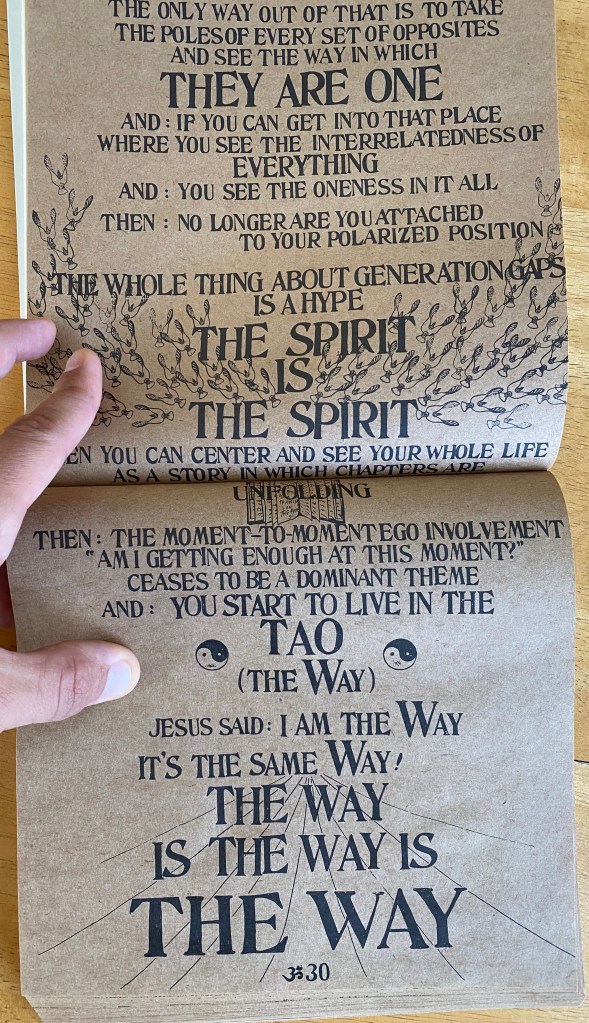
It is a glimpse into the mind of Ram at large, perhaps on psychedelics or maybe mantras and meditation. He uses a huge variety of religious philosophies and texts to describe seemingly unspeakable truths of the mystical experience. It is a no holds barred reflection on life in which Ram jumps from the Bible, to the Bhagavad Gita, to Chuang Tzu, to St. John of the Cross, to Ramana Maharshi, and many others. He stops by the Buddhists and their noble truths, and throws in some things he learned from his Guru in India.
To be completely fair, this chapter is very hard to describe. It is not something you read through like a normal book. There are so many things to stop and reflect on that relatively few words took me days to get through and not in a bad way – I didn’t want it to end. It feels almost like guided meditation. The type of thing you can pull off the shelf, flip to a random page, and just sit with for a while. You just have to read it to see.
The book wraps up with a much more practical and coherent “cookbook for a sacred life,” where Ram discusses some of the tools and practices people can use to live a better life. This includes yoga and other meditative practices, but also some guidelines on the right ways to earn a living, how to eat, and how to build some form of spiritual practice into your everyday life.
The very end of the book also includes a reading list of “books to hang out with,” “books to visit with now and then,” and “books it’s useful to have met.” This includes a couple I have already reviewed and a many more that make up my future reading list.
If you want to hear the story from Ram himself, check out the lecture below. A lot of this lecture he actually reads word for word from this book. The sense of humor that shines through in his writing is even more pronounced in his lectures.
 Dude on the Path Book Reviews