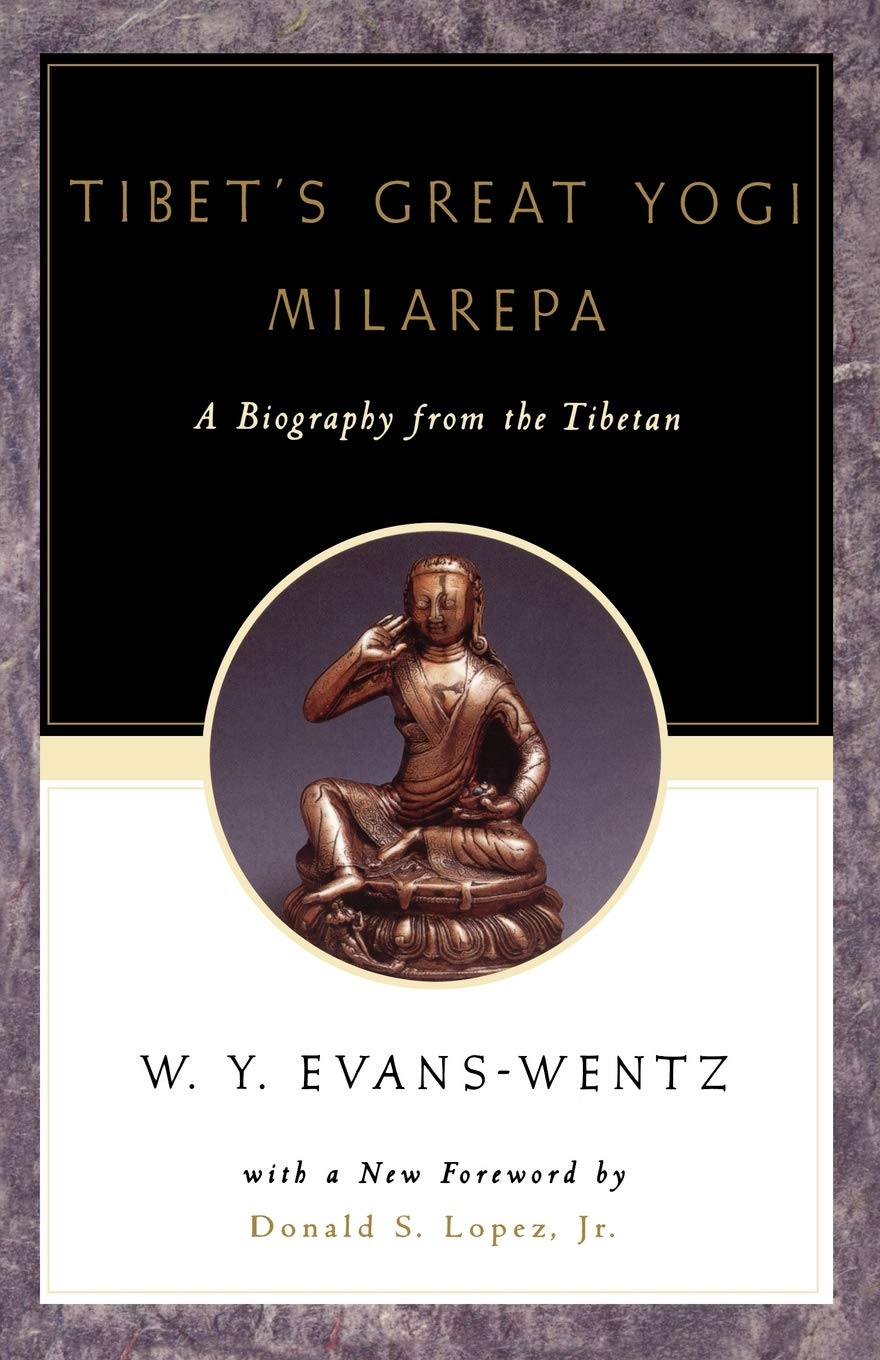
by W.Y. Evans-Wentz
Summary
This book recounts the life story and lessons of Tibetan Yogi Milarepa. Milarepa is renowned for having attained Enlightenment in one lifetime, and in this book he relays his life story to one of his disciples Rechung, the original “author” of the text. It is a story of a spiritual seeker, one who was incredibly successful in understanding important truths but also living by them with unwavering devotion.
Review
Though a book on a life lessons that involve a lot of Buddhist vocabulary that a typical Westerner would not be familiar with, this is actually one of the easier to read Buddhist books for someone with little to no background on the subject. At 310 pages it took some devotion to get through in a single week, but as a story, it is easy to stick with, and you can pick up a huge amount of Buddhist “vocab words” and concepts as you read along. Evans-Wentz spends a great deal of time explaining words and concepts a Western mind would not be familiar with in footnotes that sometimes take up the majority of a page – I learned a lot from his footnote explanations and strongly encourage a reader not to skip over them.
Reflection
If what ails our souls and our society at large is too much emphasis on “wordly” things, the life of a spiritual seeker like Milarepa is something we can all learn from. His complete rejection of worldly things to devote himself to a life of meditation and learning universal truths stands in stark contrast to what most people, Americans at least, consider a life of “success.” It is a path most people don’t even know is possible, let alone would ever consider pursuing themselves.
We emphasize the money, the cars, the houses, the looks. The likes, the comments, the shares. But did we ever stop and think if any of this is really making us happy? I think Milarepa hits the nail on the head when he describes it like this:
“All worldly pursuits have but one unavoidable and inevitable end, which is sorrow: acquisitions end in dispersion; buildings, in destruction; meetings, in separation; births, in death. Knowing this, one should from the very first, renounce acquisition and heaping up, and building, and meeting; and faithful to the commands of an eminent guru, set about realizing the truth.”
I don’t want to this to come off as the overly-negative “nothing is permanent and we are all going to die so why bother with anything in this life.” I don’t want to this to sound depressing or that I am putting down things that often do bring people happiness. But lately I have started to think of the heaping up of wealth and success similar to building fantastic sandcastles on a beach when the tide is going to come for all of them anyway. Milarepa, and many other spiritual thinkers have understood for a long time that these worldly pursuits are in vain, and do not bring us the same type of happiness as say, living a good, holy life. So perhaps we should start putting more emphasis on the latter and set about realizing the truth? Because as we all know, the truth shall set you free.
Milarepa’s radical rejection of worldly things is inspiring, but also intimidating. Much like the example of Jesus Christ, a typical person can easily be inspired by it, but not so easily replicate it. We aren’t all religious devotees of that magnitude. We can’t all give up on having an possessions and go live in a cave surviving on nettles. Some of us have to make it work living like regular people in the suburbs, myself included.
We can however, take lessons to heart. We can stop putting so much emphasis on money and career success or the worldly things we want and, I don’t know, take a walk or something. Read a book, do an activity you like “just because.” You don’t have to take restrictions to Milarepa-like extremes, but consider the way you live – can you cut out things you like but know are bad for you? Can you un-plug from the hectic nature of life and your own pursuits and be more observant and appreciative of the life you have?
Though a radically detached life like Milarepa’s may be impossible for many people, it is still possible to live a holy existence meditating on truths, even living the life of a “householder.” The story actually provides a great example of this in Milarepa’s guru Marpa the Translator. Marpa was considered a great guru, and would ultimately be the most important guru in Milarepa’s transformation. But when Milarepa first met Marpa and he was plowing his own field, he was almost in disbelief.
Marpa was a householder – he had a wife and children. He owned and worked a field. Like most of these gurus, he was kind of an odd-ball, a somewhat square peg in a circle hole for the life of a householder, but was able to be successful at it nonetheless. It was ultimately him who would bestow on Milarepa the truths that would allow him to seek enlightenment in one lifetime. When it comes to bringing enlightenment to all sentient beings, the householders play their role too.
Have you read this book before or have any questions? Let us know in the comments below!
 Dude on the Path Book Reviews